This section provides the visitor with the content and background for the subjects in the petroglyphs, such as humans, animals, and plants. It also provides interpretations of complex scenes that incorporate many figures that together convey an event. The scenes mostly depict activities relating to hunting and warfare. In this section, the visitor will learn about the people who created the rock art of Saudi Arabia and their environment.
Subjects & Scenes
Examples:
-
Hunting
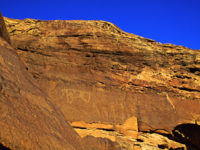
During the Neolithic, hunting scenes were prevalent. They were fairly stereotypic, with one or more of a particular prey species in the center of the scene and a hunter standing behind, poised to fire his weapon.
-

Date Palm
The trunk of the date palm is covered in upward-pointing, overlapping woody leaf bases.The palm leaf has a stout midrib that can reach 6 m (20 ft.) in length, with slender gray-green or bluish green pinnae, ranging from 20-40 cm (8-16 in) in length, emerging from it. Date palms produce inflorescences of up to 10,000 small, fragrant flowers (females are white, males are cream-colored [...]
-

Striped Hyena
The hyena has a dog-like body with strong forequarters and a back that slopes down in the rear. The neck is long and powerful and the muzzle is blunt, with powerful dentition for crushing bones. This species has a pale gray or beige body with black stripes on its sides and a black and white tail. The body hair is long and shaggy, with a crest from head to tail that stands erect [...]
-

Domestic Cattle
The domestic cattle depicted in Saudi rock art are similar in appearance to those shown in Egyptian art from the New Kingdom. Their horns are relatively long, lyre-shaped and more or less vertical. There is often a small bump at the shoulders most likely reflecting elongated thoracic spines, rather than a true hump like that found in Zebu cattle from India.