This section provides the visitor with the content and background for the subjects in the petroglyphs, such as humans, animals, and plants. It also provides interpretations of complex scenes that incorporate many figures that together convey an event. The scenes mostly depict activities relating to hunting and warfare. In this section, the visitor will learn about the people who created the rock art of Saudi Arabia and their environment.
Subjects & Scenes
Examples:
-

Gazelle
In ancient times, there were three species of gazelle in Saudi Arabia: the Mountain Gazelle, the Saudi Gazelle, now extinct, and the Sand Gazelle. Gazelles were once much more abundant on the Arabian Peninsula, but the combination of hunting and overgrazing by livestock have greatly depleted their numbers, leaving only small relict populations
-

Domestic Cattle
The domestic cattle depicted in Saudi rock art are similar in appearance to those shown in Egyptian art from the New Kingdom. Their horns are relatively long, lyre-shaped and more or less vertical. There is often a small bump at the shoulders most likely reflecting elongated thoracic spines, rather than a true hump like that found in Zebu cattle from India.
-

Ostrich
The ostrich is the largest living bird, lays the largest egg of any living avian species, and has the largest eyes of any terrestrial vertebrate. Ostriches are in the same order, Struthioniformes, with the other flightless living species, kiwis, rheas, emus, cassowaries, and the extinct moa and elephant bird.
-
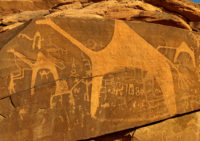
Camel
The Dromedary camel can be easily identified because of the single hump on its back. It is also the largest of all camels, having longer limbs than the Bactrian, or two-humped, camel, C. bactrianus. The Dromedary is extremely well adapted to hot, arid conditions, and is capable of surviving up to 21 days without water. Dromedaries vary in color from nearly white, to tan, to [...]