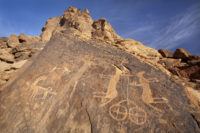
This section provides the visitor with the content and background for the subjects in the petroglyphs, such as humans, animals, and plants. It also provides interpretations of complex scenes that incorporate many figures that together convey an event. The scenes mostly depict activities relating to hunting and warfare. In this section, the visitor will learn about the people who created the rock art of Saudi Arabia and their environment.
Subjects & Scenes
Examples:
-
Canaan Dog
The dogs illustrated in the Neolithic hunting scenes at Jubbah and Shuwaymis appear to be medium-sized, with erect ears and a curly tail. They do not have a slender build or long legs like a saluki or other sighthounds, but rather have average length legs and a strong, but not massive body.
-
Ostrich
The ostrich is the largest living bird, lays the largest egg of any living avian species, and has the largest eyes of any terrestrial vertebrate. Ostriches are in the same order, Struthioniformes, with the other flightless living species, kiwis, rheas, emus, cassowaries, and the extinct moa and elephant bird.
-
Sheep
Making up 25% of the world’s domestic sheep populations, the fat-tailed type is found in Africa, the Middle East, Pakistan, North India, Western China and Central Asia. It dates back at least to 3000 BC, based on depictions found on stone vessels from Uruk, and the later Ur (2400 BCE), in Mesopotamia. These sheep were developed to increase the fat stored in their tails, which has [...]
-
Bezoar (Wild Goat)
The wild goat has long, scimitar-shaped horns that form a large semi-circle curving backward or spiral. The surface of the horns is relatively smooth or has small ripples, in contrast to the transverse ridges found on the ibex’s horns.


